by Dan Jeremiah
Head of Marketing
April 15, 2026
Key Takeaways
The frustration is familiar. You’ve invested in a Customer Success platform — maybe significantly. You’ve configured the health scores, built the playbooks, trained the team. And yet when your CRO asks what’s going to renew next quarter, you’re still pulling from a spreadsheet. When a strategic account churns, it still feels like a surprise. When expansion opportunities exist in your data, you’re still finding them after the fact.
If you’re at the point where you’re questioning whether your CS platform is the right foundation for what your team needs to accomplish, that instinct is worth taking seriously. But before committing to a rip-and-replace, it’s worth being precise about what the actual problem is — because the answer shapes the solution.
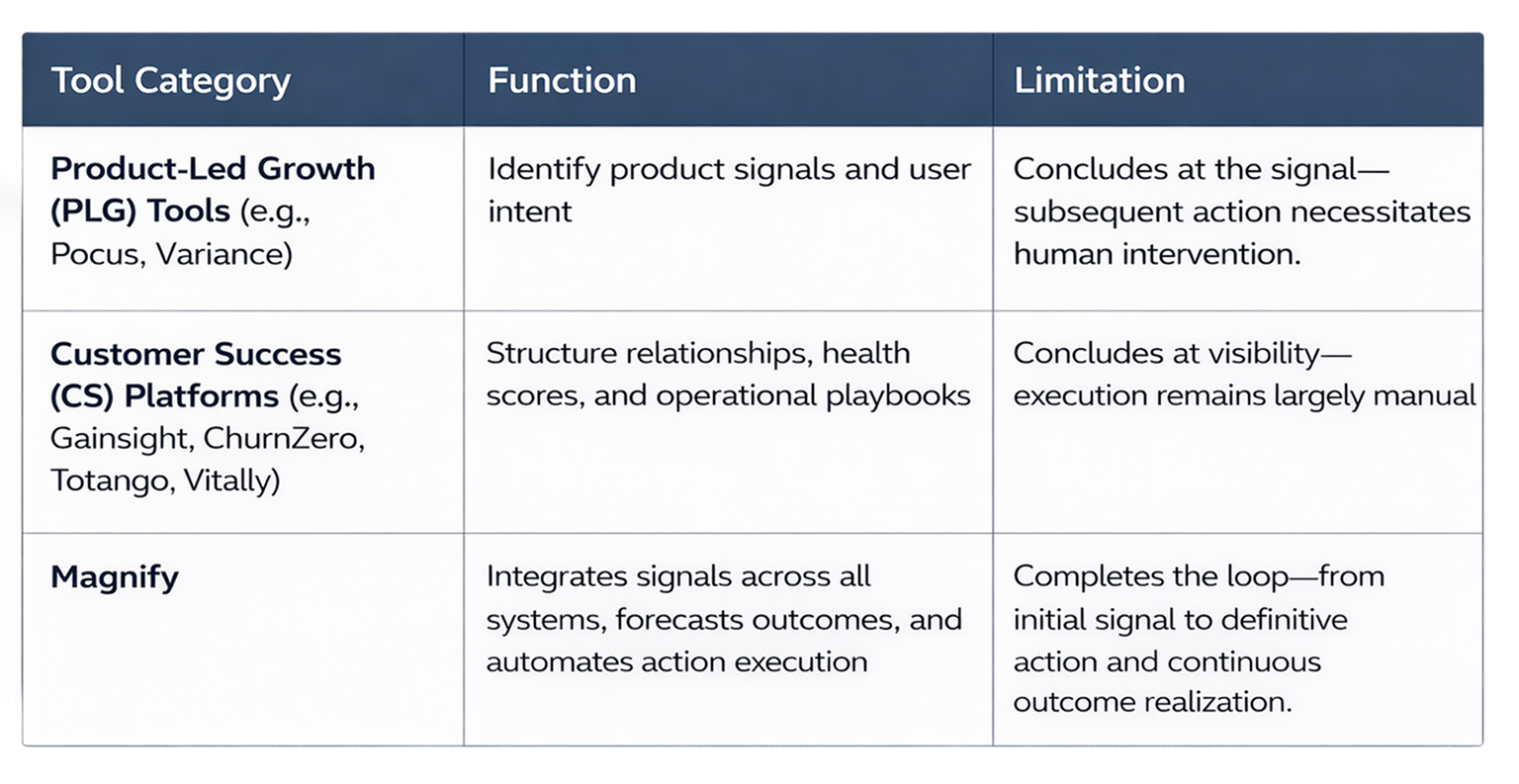
The honest framing: CS platforms like Gainsight, ChurnZero, Totango, and Vitally were built to organize the post-sales function. They manage relationships, track health, run playbooks, and give CSMs a structured operating environment. For that job, they work.
What they weren’t built for is what CS is now being asked to do: forecast post-sales revenue with board-level precision, prevent churn automatically at scale, surface expansion opportunities from behavioral signals before a human would notice them, and execute the right actions across every account simultaneously without manual intervention.
That’s not a failure of your CS platform. It’s a category limitation. The question is what to do about it.
Switching CS platforms is a significant undertaking. There’s the migration of historical data and workflow configuration. There’s the retraining of a team that has built habits and institutional knowledge around the current system. There’s the disruption to the renewal and expansion motions that are running — however imperfectly — right now.
And critically: if the root problem is that your current platform doesn’t predict revenue outcomes or execute actions automatically, switching to a different CS platform doesn’t solve it. You’d be migrating to a different version of the same category limitation.
The gap in your current setup isn’t the CS platform. It’s the layer above it — the system that should be connecting signals across your entire data stack, predicting revenue outcomes automatically, and executing the right actions without requiring a human to manually drive every motion. Here's how that gap looks like in practice:

That’s what Customer Growth Automation provides. Magnify connects your CRM, CS platform, product analytics, support data, and billing signals into a single predictive model — and then acts on what it finds, automatically, across every account.
Concretely, that means:
If you’re genuinely ready to move on from your current CS platform, Magnify can serve as the foundation for a new post-sales operating model — one built around AI-driven prediction and automated execution rather than manual workflow management. Many companies use Magnify as the operating layer that sits on top of Salesforce directly, eliminating the need for a separate CS platform entirely.
The difference between that path and a traditional CS platform switch: you’re not migrating to a better version of the same model. You’re adopting a fundamentally different one — where the system drives action automatically, and your CSMs focus on the work that actually requires human judgment.
Either way — whether you want to augment what you have or replace it entirely — the answer to your frustration isn’t another CS platform. It’s the execution layer that CS platforms were never designed to be.
Read The New Architecture of Customer Growth for the complete five-layer framework, architecture diagram, and a practical breakdown of what to build first.
Read Now